Bulletin
Integrating the Circular Economy: The Push Toward Recyclable Polypropylene and Bulk Bag Take-Back Schemes
A take-back scheme is not a sustainability gesture. It is a reverse logistics business, and it succeeds or fails on the same terms as any other.
The circular economy arrived in bulk packaging as a slogan and is now arriving as a requirement. Extended producer responsibility registration, recycled-content targets and customer sustainability audits are converging on the same practical question: what is the plan for this bag after it is emptied?
For most of the industry’s history the answer was that there was no plan, because the bag was emptied a very long way from where it was made.
Designing the bag so recovery is possible
Circularity is decided at the drawing board, not at the end of life. The single most consequential decision is monomaterial construction: fabric, webbing, thread and — where possible — closures all in polypropylene, so that a recovered bag is a single-polymer feedstock rather than a sorting problem.
Where a polyethylene liner is functionally necessary, the design choice that matters is whether it can be separated in seconds by an operator without tools. A tabbed liner that peels out is recoverable; a fully bonded liner effectively converts the whole bag into mixed waste.
Printing is the quiet offender. Heavy ink coverage, and labels in a foreign polymer, both degrade the value of the recovered material. Restraint in artwork has a measurable end-of-life value.
What a take-back scheme actually requires
The material science is settled; the logistics are not. A workable take-back arrangement needs four things, and the absence of any one of them collapses it.
It needs aggregation — a point where enough empty bags accumulate to fill a return vehicle. This is why schemes start with high-volume single-site users and struggle with distributed ones. It needs a return leg, ideally a vehicle already making the journey empty, because dedicated collection transport rarely survives the economics. It needs a contamination standard agreed in advance, so that a returned consignment is not rejected on arrival after everyone has paid for the freight. And it needs a destination: a recycler, or an in-house recycling operation, that can actually take the material and turn it into something with a market.
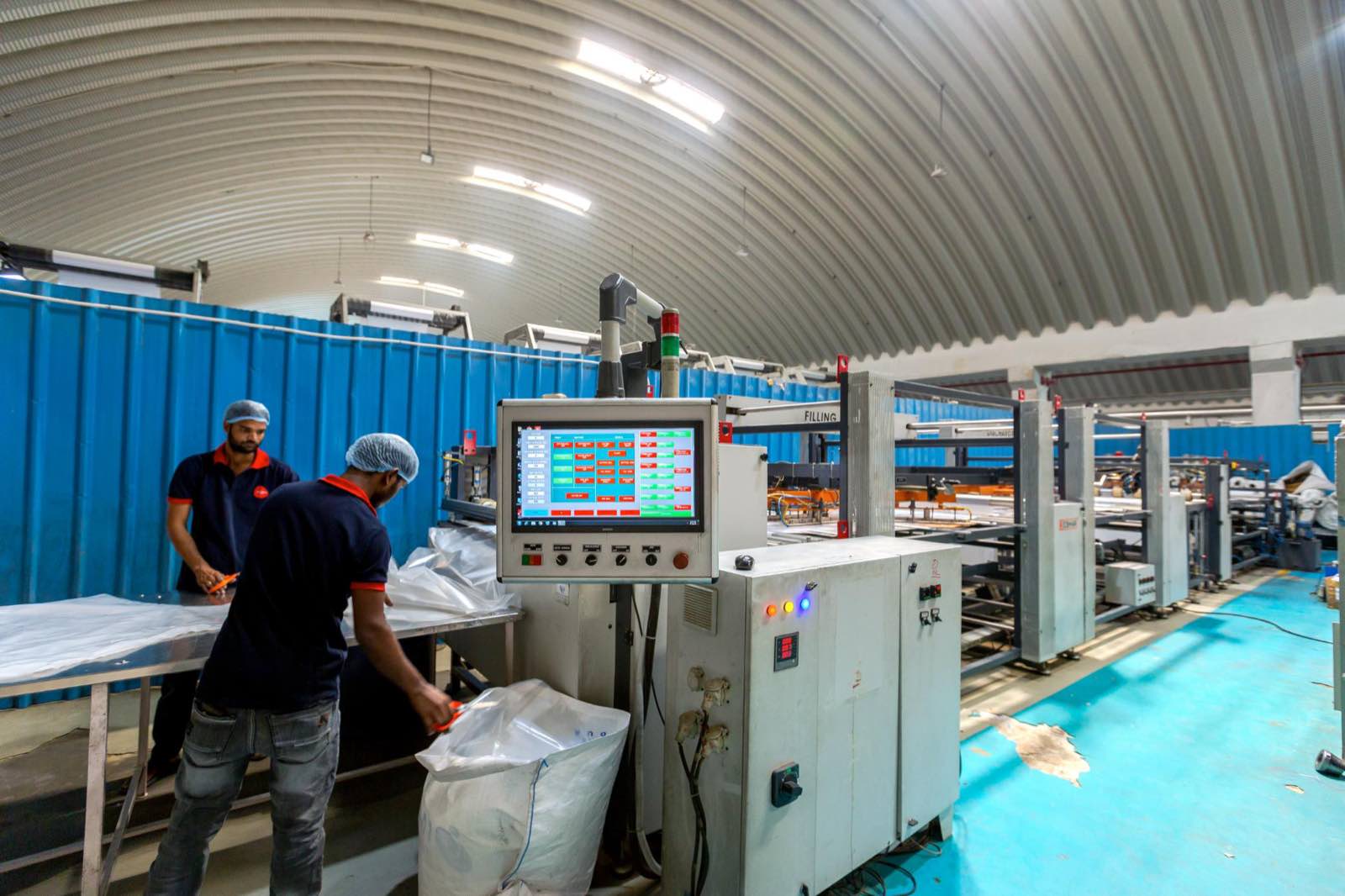
That last point is where integrated manufacturers have a structural advantage. A group that operates its own polymer recycling division can take back material, reprocess it, and place the recovered polymer into non-food applications within its own product range — closing the loop inside one organisation rather than across four.
Where recycled polypropylene can and cannot go
Honesty about this matters more than ambition. Recovered polypropylene from used bulk bags is well suited to non-food applications: construction fabrics, ground covers, industrial sacks, pallet components, and the internal non-contact parts of packaging. It is not suitable for direct food contact, and any supplier claiming otherwise should be asked for the documentation immediately.
This creates a natural two-stream model. Virgin resin serves food, pharmaceutical and cleanroom production. Recovered polymer serves industrial applications. Both streams run in the same plant without ever meeting, and the separation is auditable.
What buyers should ask for
Three requests move a supplier relationship from stated intent to something verifiable. Ask for the bag’s material composition by polymer, not by weight of plastic — this exposes mixed-material construction immediately. Ask whether a take-back route exists for your specific site, and what volume triggers it. And ask what the recovered material becomes, because a recycler who cannot name the downstream product is describing disposal.
The direction of travel
Regulation will keep tightening, and the manufacturers who have already built monomaterial designs, recycling capacity and return logistics will find compliance to be a matter of record-keeping rather than reinvention. Those who have treated circularity as messaging will find it becomes a procurement barrier quite suddenly.
The bulk bag is, physically, one of the better candidates for genuine circularity in industrial packaging. Whether it becomes one is a question of logistics and commitment, not chemistry.
Certified to the standards global brands demand




Ready to secure your supply chain?
Tell us your material, load and handling requirements — our export desk will specify the right bag and come back with a quote.