Bulletin
Food-Grade FIBCs: What Makes a Bulk Bag Safe for Consumables?
Food grade is not a label you print on a bag. It is a chain of decisions that starts at the polymer and ends at the seal on the outer wrapper.
When a buyer asks for a food-grade FIBC, they are rarely asking about the bag alone. They are asking whether a tonne of milk powder, sugar, starch or spice can sit inside that bag for weeks, cross an ocean, and arrive fit to enter a production line that feeds people. That is a question about the whole manufacturing chain, not about a single specification line.
It begins with virgin polymer
A genuinely food-grade bag starts with virgin polypropylene resin, produced without recycled content and without the recycled additives that can carry unknown history. Recycled polymer has its place — and a very important one, as we have written elsewhere — but it does not belong in direct food contact. The resin, the master batches and any UV stabiliser used must all be traceable, and each must be declared suitable for food contact under the frameworks the destination market recognises: Regulation (EC) 1935/2004 and Regulation (EU) 10/2011 in Europe, and the relevant sections of FDA 21 CFR in the United States.
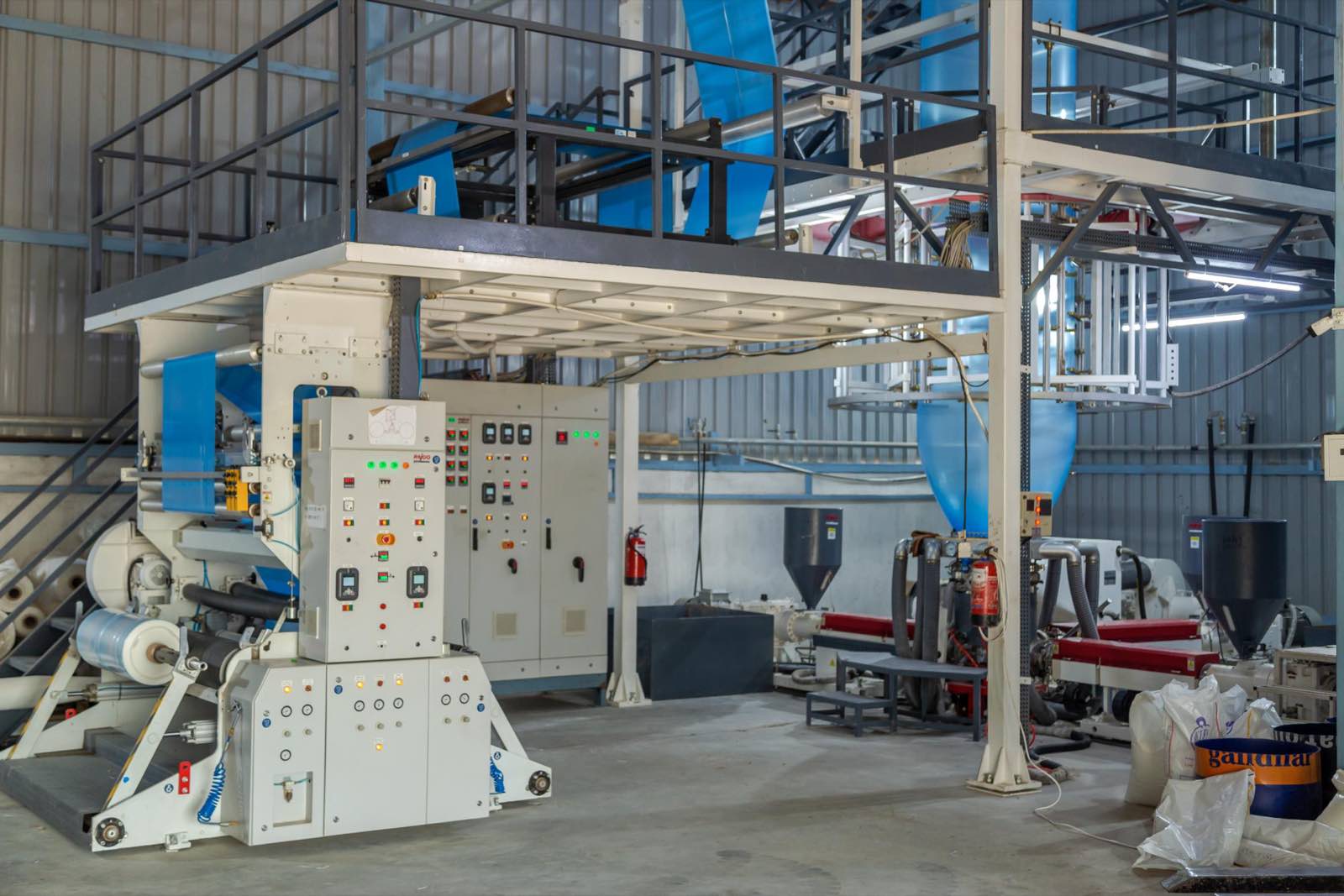
This is where vertical integration stops being a marketing word and starts being a control. A manufacturer that extrudes its own tape from resin it purchased itself knows exactly what is in the fabric. A manufacturer that buys woven fabric on the open market is trusting a document.
The cleanroom question
Contamination in a bulk bag is very rarely chemical. It is physical — a fibre, a hair, a fragment of plastic, an insect, a flake of paint from a roof beam. None of these survive contact with a food safety auditor, and none of them are caught by a certificate. They are caught by the room the bag is assembled in.
An ISO Class 6 cleanroom, classified under ISO 14644-1, controls airborne particle count, air changes and pressure differential. Operators enter through a change area in dedicated garments. Metal detection screens the finished bag. Tools are controlled and counted. The bag is sealed inside its liner and outer wrapper before it leaves the controlled zone, so the last environment it sees is the clean one — not the dispatch bay.
The practical test of a supplier is simple: ask where the bag is sewn, printed and folded, and whether those three operations happen in the same air.
Certification is evidence, not a promise
BRCGS Packaging Materials is the standard most food and pharmaceutical buyers now treat as a threshold, and Grade A is the level that signals a mature, audited system rather than one built for the audit. It covers hazard analysis, site security, foreign-body control, traceability and recall — the things that determine whether a problem is contained in an hour or discovered by a customer.
Alongside it sit the market-access certifications: HALAL and Kosher, which govern what may be handled on shared equipment; and ISO 21898, which sets out the construction and testing requirements for FIBCs carrying non-dangerous goods, including the safe working load and safety factor the bag is rated to.
None of these are decorative. A Kosher certificate that does not cover the specific production line is worth nothing at the port.
Sift-proof construction and the liner decision
Fine powders find every needle hole. A standard sewn seam is a sieve at 30 microns, which is why food-grade bags for powdered product are built sift-proof — single, double or triple, depending on particle size — using folded seams, seam tape or a combination of both.
The liner is the second decision, and it is often made too quickly. A loose liner is cheap and easy to fill but can fold, trap product and complicate discharge. A glued or tabbed liner holds its shape against the bag wall and empties cleanly. A form-fit liner, shaped to the bag, is the right answer for free-flowing powders where discharge residue is a yield loss. Where the liner is formed matters as much as the bag: a liner extruded and formed in-house, in the same controlled conditions, does not import someone else’s contamination risk.
What to ask a supplier
Four questions separate a food-grade supplier from a supplier with a food-grade certificate. Where does your resin come from, and can you show its food-contact declaration? In what class of room is the bag assembled and sealed? Which of your certifications cover the exact line my bag will run on? And can you trace a finished bag back to the resin lot it came from?
A supplier who can answer all four quickly is a supplier whose system works when nobody is watching. That, in the end, is what food grade means.
Certified to the standards global brands demand






Ready to secure your supply chain?
Tell us your material, load and handling requirements — our export desk will specify the right bag and come back with a quote.